
Special Educational Needs
Wallington County Grammar School is ambitious for all our pupils and we believe that there is no ceiling on what can be achieved by anyone, regardless of their circumstance or background. We are committed to providing a supportive and inclusive learning environment, giving every young person the opportunity to fulfil their potential now, and in the future.
The leaders at Wallington County Grammar School are leaders for all pupils, enabling our teachers to be teachers of all pupils. Wallington County Grammar School is committed to distributed leadership to secure the best possible provision and outcomes for pupils with special educational needs. We have the same ambition for all our pupils, and recognise the importance and impact of prioritising our responsibilities to pupils with special educational needs.
We work in partnership with pupils and their families in identifying and providing for special educational needs. Where appropriate, we also work in partnership with other agencies. We recognise the importance of communication being inclusive, accessible and culturally sensitive to achieve effective partnership working.
Wallington County Grammar School – SEND Graduated Approach
The graduated approach is the structured process schools use to identify, support and review the progress of learners with SEND. It follows a four-stage cycle: Assess, Plan, Do, Review (APDR).
|
Wave |
Name of the support |
Provision required |
Link to the SEN Code of Practice |
Support and provision |
Assessment, recording and monitoring system |
Monitored by |
|---|---|---|---|---|---|---|
|
1 |
|
|
"High quality teaching, differentiated for individual pupils, is the first step in responding to pupils who have, or may have, SEN. Additional intervention and support can not substitute for a lack of good quality teaching." Code of Practice 6.37 Educational Needs (SEN). |
|
|
|
|
2 |
Targeted Support |
Small group and one-to one interventions are in place to support students with a range of needs. These include, but are not limited to, targeted support for literacy, numeracy, home learning, speech language and communication and social emotional and mental health needs. These interventions are in house |
"Where a pupil is identified as having SEN, schools should take action to remove barriers to learning and put effective special educational provision in place." Code of Practice 6.44 |
In addition to stage 1:
|
|
|
|
3 |
Specialist support |
Specialist support is provided for a range of individual needs. The school liaises closely with professionals from a range of external agencies. This includes, but is not limited to, speech and language therapist, educational psychologist, hearing impairment specialist, counsellor and CAMHS. |
"SEN support should be adapted or replaced depending on how effective it has been in achieving the agreed outcomes." Code of Practice 6.63 |
In addition to stage 1-2:
|
|
|
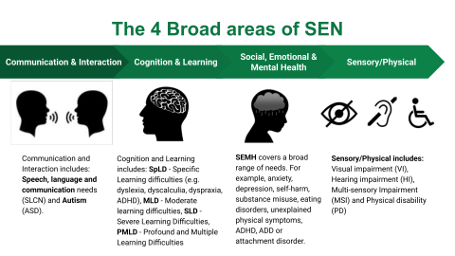
What does it mean to have a Special Educational Need?
A pupil has SEN if they have a learning difficulty or disability that requires special educational provision to be made for them.
They have a learning difficulty or disability if they have:
-
A significantly greater difficulty in learning than most others of the same age; or
-
A disability that prevents or hinders them from making use of facilities of a kind generally provided for others of the same age in mainstream schools.
Special educational provision is educational or training provision that is additional to, or different from, that made generally for other children or young people of the same age by mainstream schools.
SEND students are greeted at the school gate each AM with a smile and a good morning. They have the option of being with peers in the canteen, playground, their form room or in Pastoral 4. Pastoral 4 is a dedicated SEN room, supervised by a member of the SEN team to support students to navigate school life. During form time, SEND students have their equipment checked, to ensure that they are ready for the school day. Students peacefully and calmly journey to and from each of their lessons, with orderly behavior, with various members of SLT patrolling the corridors. Lessons are highly inclusive and showcase quality first teaching. SEND students are supported in lessons by highly designed IEPs that are followed by all staff, in all lessons. Social time such as break and lunch time, can be spent in social areas such as playgrounds or in the canteen, however if a quieter retreat is needed, pastoral 4, is a place to relax, regulate, process and build friendships. Students are spoiled for choice, through our vast array of options for club attendance. As well as club time, there is form time or assembly time, which are options to develop the whole child, by listening to assemblies on e -safety, mental health and anti-sexism. SEND students are supported throughout their day via academic, pastoral and SEN staff.
Our SEND Team
|
Staff member |
Role |
SEN vision for SEN at WCGS |
|---|---|---|
|
Asma Farshori
|
SENDCo Assistant |
WCGS provides expert, personalised support to enable all students with special educational needs to reach the heights and access world-class universities when they leave us. We want our students to be happy, healthy, ambitious, resilient and to have a high awareness of their diagnosis and how best to manage it. |
|
Marianne Osborne
|
Learning Support Assistant |
WCGS provides expert, personalised support to enable all students with special educational needs to reach the heights and access world-class universities when they leave us. We want our students to be happy, healthy, ambitious, resilient and to have a high awareness of their diagnosis and how best to manage it.
|
|
Richa Shukla
|
Learning Support Assistant |
WCGS provides expert, personalised support to enable all students with special educational needs to reach the heights and access world-class universities when they leave us. We want our students to be happy, healthy, ambitious, resilient and to have a high awareness of their diagnosis and how best to manage it. |
|
Steph Greenhalgh
|
Learning Support Assistant |
WCGS provides expert, personalised support to enable all students with special educational needs to reach the heights and access world-class universities when they leave us. We want our students to be happy, healthy, ambitious, resilient and to have a high awareness of their diagnosis and how best to manage it. |
|
Duvessa Owen
|
Deputy Headteacher |
WCGS provides expert, personalised support to enable all students with special educational needs to reach the heights and access world-class universities when they leave us. We want our students to be happy, healthy, ambitious, resilient and to have a high awareness of their diagnosis and how best to manage it. |


Identification and assessment of children with SEND
To identify students with SEN, Wallington County Grammar School will:
-
Before being admitted to the school, we will analyse the student’s school file/ transition documents and CPOMS to see if we can see any unidentified SEN concerns, and place students on our watch list;
-
Assess each student’s current skills and levels of attainment via a data staging post;
-
Make regular assessments of all students in all subjects so that any concerns can be raised by subject teachers or the pastoral team;
-
Students who are deemed in need of special educational assessment by teachers will be referred to the SENDCo. The SEN team/ pastoral team will gather information and evidence to ascertain whether a student has a learning difficulty and continues to make inadequate progress, despite high-quality teaching targeted at their areas of weakness. The SEN team will then share any concerns highlighted with parents/carers before liaising with appropriate agencies to formalise the assessment procedure; support will then be given and reviewed as appropriate following advice from these agencies;
-
Once identified, ensure that the student makes progress in line with their ability;
-
Ensure that the student’s progress is in line with what they can achieve;
-
Match or better the student’s previous rate of progress where possible;
-
Closes the attainment gap between the child and their peers;
-
Prevents the attainment gap growing wider.
We will assess each pupil’s current skills and levels of attainment on entry, via class assessments, an early Year 7 and 12 report, and a November (Year 12) and January (Year 7) assessment period in each subject.
Class teachers will make regular assessments of progress for all pupils and identify those whose progress:
-
Is significantly slower than that of their peers starting from the same baseline
-
Fails to match or better the child’s previous rate of progress
-
●ails to close the attainment gap between the child and their peers
-
Widens the attainment gap
This may include progress in areas other than attainment, for example, personal, social and emotional development.
Slow progress and low attainment will not automatically mean a pupil is recorded as having SEN. Other barriers to learning will also be considered.
A referral system is also in place for teachers to raise concerns with the SENDCO if they feel that a pupil may require support which is different from or additional to that which is delivered as part of the core offer.
As part of the graduated approach, any referral includes strategies that the teacher has already implemented and their impact.
Parents/carers can also raise concerns either with the class teacher/ form tutor/ Year Leader/ Key Stage Leader or SENDCo.
When deciding whether special educational provision is required, we will start with the desired outcomes, including the expected progress and attainment, and the views and the wishes of the pupil and their parents. We will use this to determine the support that is needed and whether we can provide it by adapting our core offer, or whether something additional is needed.
Individual Education Plan
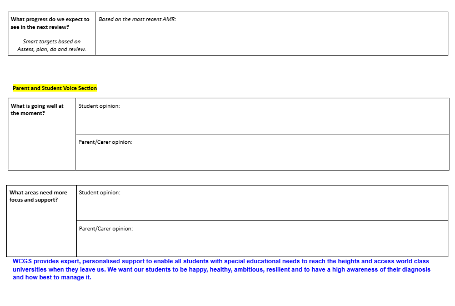
All students on the SEND register will have an Individual Education Plan (IEP). An IEP is a regularly reviewed document that contains the needs, strengths and individual strategies for every student. These are developed in partnership with pupils and their parents/carers. Where appropriate, they might also include strategies recommended by other professionals.
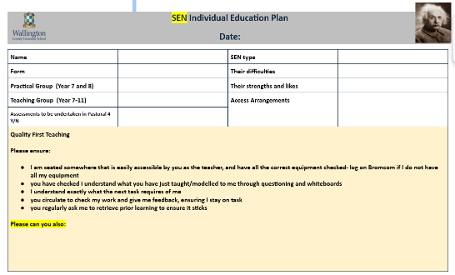
Universal provision – high quality teaching
Wallington County Grammar School ensures that a universal provision of high-quality teaching is able to address gaps in foundational knowledge and skills. Through evidence-informed classroom routines and a well-planned curriculum, teachers are able to address reading fluency and accuracy, communication and language skills, writing composition and number facts. Furthermore, our carefully selected and sequenced curricula ensure foundational subject-specific knowledge is secure at every step. For some students, effective in-classroom targeted support ensures gaps are identified and tackled quickly through our responsive and adaptive classroom practice.
At Wallington County Grammar School, our motto – Per Ardua ad Summa, ' Through Difficulties to the Heights' is at the heart of everything we do. Our broad and deep curriculum challenges and inspires students, building their knowledge and confidence across a wide range of subjects. Alongside this academic excellence, strong pastoral care ensures every student is supported to thrive personally and academically.
Our curriculum reflects four key intents. They are :
Breadth - we intend to provide a broad, academic and liberal curriculum that equips students with the body of human knowledge and different ways of thinking necessary to succeed in and enjoy their education, careers and wider lives.
Depth - we do not want our students to simply study the national curriculum and examination specifications with grades being our sole focus. We aim for our students to become true scholars of the disciplines that they are learning so that they achieve a deep and sophisticated level of knowledge and understanding.
Values - we aim for our students to develop our four core values of commitment, courage, compassion and creativity.
Democracy - we aim for all our students to have the necessary knowledge and confidence, not just to participate in the democracy of the United Kingdom, but to lead it.
Click the link below to view the WCGS curriculum maps for all subjects.
Wallington County Grammar School - Course Information
The curriculum intent can be found here:
Useful links
Teacher Handbook: SEND
With contributions from specialists across the sector, the handbook is a comprehensive resource for teachers and parents to use over time. It brings together practical examples of high-quality teaching - placing focus on removing barriers to learning, getting to know and understand individual learners, and bringing to life the graduated approach. To access this free resource click on the link below and sign up to Whole School SEND:
Whole School SEND Online CPD Units
Free, flexible online learning to help develop inclusive practice.
WCGS SEN Information Report
Sutton Local Offer